
Finding the right round table dining set for a large family or frequent gatherings requires balancing seating capacity with room proportions. Rather than relying on generic size charts, determining the ideal diameter involves calculating the space each person needs, measuring your specific dining chairs, and verifying room clearances. A standard round table dining set designed for daily family use must accommodate the physical realities of your home’s layout and the specific design of your seating. While a diameter of 120 to 140 centimeters typically accommodates six diners, expanding that capacity to eight or ten people requires a table measuring 150 to 180 centimeters or more. This guide walks you through the practical steps to size a round table for 6 to 10 seats without overcrowding your dining area.
Understanding Space Requirements for 6 to 10 Seats
To determine how many people can comfortably gather around a round table dining set, you must first analyze the physical variables of your seating. Dining chairs vary significantly in width, depth, and design. Standard armless dining chairs generally measure between 45 and 50 centimeters in width, whereas chairs with armrests or heavy upholstery can easily exceed 55 to 60 centimeters. This extra width directly impacts how many chairs can sit flush against the table edge.
Beyond the physical width of the chair, each diner requires adequate elbow room to eat comfortably without bumping into neighbors. A reliable baseline for comfortable dining is an arc length of 60 to 65 centimeters per person along the table’s perimeter. If you regularly host formal dinners where multiple utensils, large plates, and serving platters are used, this requirement can increase to 70 centimeters per person.
Products mentioned in this guide

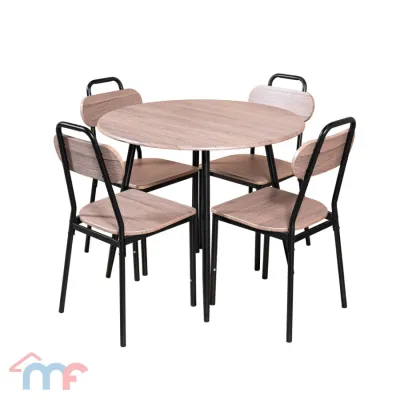




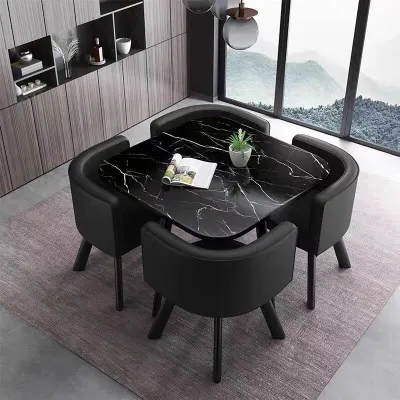

Prices are valid at publication and may change. Please refer to the product page for the latest price.
The design of the table base also plays a critical role in seating capacity and legroom. Traditional four-legged tables restrict chair placement because the legs create physical barriers at the corners. In contrast, a central pedestal base eliminates these corner obstructions, allowing for more flexible chair alignment. However, you must verify the pedestal’s footprint; a very wide or bulky base can restrict foot space and prevent chairs from being pushed fully under the table when not in use.
How to Calculate the Ideal Table Diameter
Estimating the necessary table diameter for your household does not require complex math, but it does require accurate measurements of your existing or planned dining chairs. Start by measuring the widest point of your chairs, which is typically the front of the seat or the outermost span of the armrests. If you plan to use a mix of side chairs and armchairs, use the larger measurement as your baseline to ensure everyone has equal space.

Once you have the chair width, add at least 10 to 15 centimeters of clearance on either side of each chair to account for natural movement and elbow room. Multiply this total individual space requirement by the number of seats you wish to accommodate. For example, if your target is eight seats and each seat requires 70 centimeters of perimeter space, you will need a total table circumference of 560 centimeters.
To convert this circumference into the required table diameter, divide the total circumference by pi (approximately 3.14). In this scenario, a 560-centimeter circumference divided by 3.14 yields a minimum diameter of approximately 178 centimeters. Always cross-reference your calculated diameter with the manufacturer’s specifications. Manufacturers often list a maximum seating capacity alongside a recommended everyday capacity; prioritizing the everyday comfort level prevents a cramped dining experience.
Measuring Your Dining Room for Clearance and Flow
A round table dining set must not only fit its occupants but also fit harmoniously within your dining room. To maintain comfortable traffic flow, measure the distance from the table’s edge to the nearest wall, cabinet, or doorway. A minimum clearance of 90 centimeters is necessary to allow diners to pull out their chairs and sit down comfortably. For high-traffic pathways where family members must walk behind seated guests, increase this clearance to 120 centimeters.
In tropical climates like the Philippines, indoor air circulation is vital for comfort. Dining rooms often feature large ceiling fans or overhead light fixtures centered over the table. When planning your layout, verify that the table is perfectly aligned beneath these fixtures to maintain safe headroom and balanced lighting. Ensure the fan blades do not extend past the table’s edge to prevent uncomfortable downward drafts directly onto diners’ plates.
Before finalizing your purchase, carefully map out the delivery route from your home’s entrance to the dining area. Measure the width and height of all doorways, hallways, stairwells, and elevator cabins. Large round tables, especially solid wood or stone models with non-detachable tops, can be exceptionally difficult to maneuver through tight corners. Confirm whether the table top and base ship in separate boxes and verify the assembly requirements to avoid delivery day complications.
Evaluating Extendable Round Table Designs
If your daily household consists of six people but you frequently host up to ten guests for Sunday lunches or holiday gatherings, an extendable round table dining set offers an adaptable solution. These tables typically feature a split-top design that accommodates one or more self-storing or separate extension leaves. When closed, the table maintains a compact round shape; when opened, it transforms into an oval or elongated round shape.
When evaluating these designs, pay close attention to the extension mechanism. High-quality gear-driven slides or smooth wooden runners are essential for easy operation, especially in humid environments where wood can swell. Inspect the structural stability of the table when fully extended. As the table length increases, the center of gravity shifts, making robust joinery and a heavy, stable base critical to prevent tipping when guests lean on the outer edges.
Compare the spatial footprint of the table in both its collapsed and fully extended states. Ensure your dining room can accommodate the maximum extended length while still maintaining the minimum 90-centimeter clearance for walkways. If the extended table blocks a major pathway, consider whether you can temporarily reposition adjacent furniture during large gatherings to preserve a comfortable flow.
Common Sizing Mistakes to Avoid
One of the most frequent mistakes when choosing a round table dining set is overlooking the physical volume of the table base. While pedestal tables are excellent for legroom, a base that is too light or poorly engineered can cause the table to wobble, especially on tiled or uneven floors. Conversely, an excessively wide pedestal can block your guests’ feet, forcing them to sit at uncomfortable angles.
Another common oversight is failing to account for the thickness of upholstered chairs. Padded dining chairs often flare outward at the back or have thick cushions that do not tuck neatly under the table apron. This can leave chairs protruding into the room’s walkways even when the table is not in use, making the dining area feel permanently cluttered.
Finally, do not underestimate the visual dominance of a large round table. Unlike rectangular tables that can be pushed against a wall to save space, a round table must sit in the center of the room to remain functional. A table with a diameter exceeding 160 centimeters can easily overwhelm a small or narrow dining room, making the entire space feel cramped regardless of the actual clearance measurements.
Frequently Asked Questions (FAQ)
How do I know if my dining chairs will fit around a specific round table?
To verify if your chairs will fit, measure the widest part of a single chair and multiply that number by the total number of chairs you plan to use. Add 15 centimeters of spacing between each chair to ensure adequate elbow room. Compare this total required width to the table’s circumference (diameter multiplied by 3.14); if the table’s circumference is smaller than your calculated total, the chairs will be too crowded.
Are pedestal bases better for seating more people?
Pedestal bases generally offer superior seating flexibility compared to four-legged tables because they eliminate corner leg obstructions, allowing you to squeeze in extra chairs when needed. However, you must check the manufacturer’s stability ratings and base weight. Ensure the pedestal is heavy enough to prevent tipping, particularly when the table is fully loaded with heavy serving dishes or when using an extendable model.

Community discussion
Share your experience or ask a question. Comments are reviewed before publication.